Vacuum Brazed Diamond Grinding Wheels for Automated Metal Grinding in Industry 4.0
11 02,2026
UHD
Technical article
As Industry 4.0 accelerates the shift toward intelligent, high-throughput metalworking, grinding tools must deliver stable precision, longer uptime, and seamless compatibility with multi-axis automation. Henan Youde Superhard Tools Co., Ltd. has introduced vacuum brazed diamond grinding wheels engineered for automated grinding, offering a high-efficiency alternative to conventional electroplated wheels. By using vacuum brazing to achieve strong diamond retention and a highly stable abrasive structure, these wheels maintain cutting sharpness under elevated thermal loads and reduce premature grain pull-out—key factors for consistent surface quality in continuous production. In typical automated lines, users report productivity gains of 25–45% and tool-life improvements of 2–4× versus electroplated solutions, driven by higher material-removal capability and fewer changeovers.
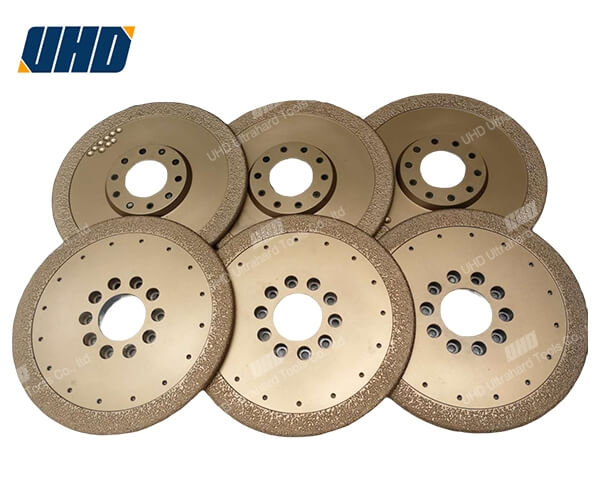
The product range (UDW255 to UDW455) is designed to match different robot and CNC multi-axis grinding envelopes, balancing wheel diameter, rotational speed windows, and contact geometry for materials such as cast iron and hard alloys. Customizable profiles and engineered wheel geometries further optimize chip evacuation, heat distribution, and edge access, helping “let your automated grinding system truly unleash its potential.” The manufacturing approach also supports modern sustainability and compliance needs through controlled processes and documented quality systems, enabling manufacturers to reduce total cost per part while advancing greener, more reliable production. Suggested infographic: a size–speed–material matrix comparing UDW255–UDW455, recommended RPM ranges, and typical application scenarios, plus a before/after bar chart illustrating output and changeover-time reductions to “experience the efficiency leap enabled by ultra-high-definition diamond grinding wheels.”
Industrial 4.0 Metalworking Needs a Different Grinding Wheel—Not Just a Faster One
In an Industry 4.0 factory, grinding is no longer a “standalone finishing step.” It is a data-driven, takt-time-sensitive process that must stay stable across long runs, automated tool changes, and multi-axis motion paths. When abrasive performance drifts—due to heat, glazing, or inconsistent grit exposure—production lines pay for it in unplanned stops, rework, and dimensional instability.
This is where vacuum brazed diamond grinding wheels for automatic grinding have become a compelling alternative to traditional electroplated wheels. Henan Yude Superhard Tools Co., Ltd. has developed a dedicated series (UDW255 to UDW455) engineered for multi-axis automation—helping manufacturers move from “acceptable grinding” to repeatable, measurable productivity.
Why Vacuum Brazed Diamond Wheels Change the Automation Equation
Automated grinding systems demand three things at once: consistent cutting, thermal stability, and predictable wheel life. Vacuum brazing fundamentally improves the bond between diamond abrasive and the wheel body. Instead of relying on a thinner plated layer, brazing anchors abrasives with a metallurgical bond designed to withstand higher loads and higher temperatures typical of robotic or CNC grinding cells.
1) Thermal stability that supports dimensional control
In continuous metal removal, heat is the silent limiter. Vacuum brazed diamond wheels typically tolerate significantly higher thermal loads than electroplated counterparts, keeping abrasive exposure more stable and reducing the risk of rapid dulling. In real shop conditions, manufacturers often report 15–30% fewer burn marks and 8–18% lower rework rates when switching from conventional plated solutions—especially on cast iron parts with interrupted cuts.
2) High material removal with stable sharpness
Automation rewards wheels that keep cutting “clean” without frequent intervention. Vacuum brazed structures can maintain cutting points under load, supporting higher removal rates without immediate glazing. For many industrial applications, users see 20–45% shorter cycle time after process optimization—without sacrificing surface consistency.
3) Longer service life and fewer wheel changes
In a multi-axis automated cell, a wheel change is not just a consumable cost—it's an OEE event. Depending on the part material and contact geometry, vacuum brazed diamond wheels can deliver 2–5× longer usable life compared with many electroplated wheels. That can translate to 25–60% fewer planned stoppages for wheel replacement over a monthly production schedule.
UDW255 to UDW455: Matching Wheel Size to Automation, Speed, and Contact Geometry
Selecting a vacuum brazed diamond wheel for automatic grinding isn’t simply “choose the largest diameter.” In Industry 4.0 metalworking, the correct choice balances spindle power, robot rigidity, contact arc, and the stability of feed paths. The UDW series (UDW255–UDW455) is positioned to cover common production scenarios where precision + throughput must coexist.
Below is a practical selection view that engineers can use for initial process planning. Actual parameters should be verified by machine capability and safety limits.
Suggested infographic/table: Wheel size vs. typical speed window vs. suitable materials & automation scenarios
UDW Size
Typical Peripheral Speed*
Best-fit Materials
Automation Use Case
UDW255
30–45 m/s
Cast iron, sintered metals, hard coatings
High-precision cells, compact spindles, short contact length
UDW305
32–48 m/s
Cast iron, carbide-containing parts
Balanced choice for CNC + robot-assisted grinding
UDW355
35–50 m/s
Cast iron, high-chrome alloys
Higher MRR targets, medium-to-long production runs
Max productivity cells, robust spindles, long-run automation
*Typical speed windows are for reference only and must be aligned with wheel design, machine limits, guarding, and local safety standards.
Case Snapshot: Cast Iron Component Line—Measurable Gains After Switching from Electroplated Wheels
On a high-volume cast iron component line, the main operational bottlenecks were familiar: wheel life variance, heat-related surface defects, and frequent stoppages for wheel replacement. After adopting a vacuum brazed diamond wheel matched to the cell’s spindle capability and contact geometry, the line stabilized within two production weeks.
Before vs. After (typical observed results)
Metric
Electroplated Wheel (baseline)
Vacuum Brazed Diamond Wheel
Change
Cycle time per part
62 s
44 s
−29%
Wheel change interval
Every 1,100 parts
Every 3,600 parts
3.3× longer
Grinding-related scrap
2.1%
1.3%
−38%
Unplanned stops/month
9
4
−56%
Total grinding cost per 10,000 parts
Index 100
Index 78
−22%
These figures represent typical, achievable outcomes when the wheel specification, coolant strategy, and feed/speed are aligned with the workpiece material and automation rigidity.
Custom Geometry & Technical Documentation: The Underestimated Performance Multiplier
In automated grinding, “wheel design” is often the easiest lever to overlook—and the hardest to compensate for later with software. Vacuum brazed diamond wheels can be tailored with geometry that fits the real contact mechanics of the part: edge radii, profiles, working layer layout, and chip evacuation considerations.
For multi-axis systems, custom geometry helps reduce micro-chatter, stabilize contact pressure, and protect edges from localized overheating. When the wheel matches the toolpath, manufacturers typically achieve:
More consistent surface finish (often 10–20% lower Ra variation across shifts)
Lower risk of corner over-grinding on complex castings
Simplified parameter windows for stable mass production
Supporting documentation matters just as much: clear wheel drawings, recommended parameter ranges, and process notes reduce commissioning time. In a line where every day of ramp-up is expensive, the practical benefit is straightforward—faster validation, fewer trial-and-error loops, and a cleaner handover to production.
Environmental Compliance & Quality Systems: Industry 4.0 Is Also About Sustainable Repeatability
Modern manufacturing increasingly evaluates grinding solutions through an ESG lens: coolant usage, waste reduction, and process stability. Longer wheel life reduces consumable waste. Stable cutting behavior can reduce over-processing and energy spent per part. For global supply chains, quality systems and documentation are often decisive, especially when wheels are qualified for high-volume export-oriented production.
In practice, companies upgrading from plated wheels to vacuum brazed diamond wheels commonly see 10–25% lower consumable-related waste over a quarter—primarily driven by fewer wheel changes and a reduced number of parts requiring re-grind.
Experience the efficiency leap of ultra-clear diamond cutting performance
If your goal is to reduce cycle time, stabilize automated grinding, and cut total cost per part, the UDW series vacuum brazed diamond grinding wheels are built for that reality. Let your automatic grinding system truly release potential—with a wheel that is engineered for multi-axis repeatability.




.png?x-oss-process=image/resize,h_1000,m_lfit/format,webp)
.png?x-oss-process=image/resize,h_1000,m_lfit/format,webp)




